Enlisted promotions, the cornerstone of military career progression, offer a pathway to recognition, responsibility, and advancement. From the initial enlistment to the pinnacle of senior ranks, the journey is marked by challenges, opportunities, and a constant drive to excel. The promotion system, while designed to ensure competence and experience, is a complex tapestry woven with time-in-grade requirements, performance evaluations, and a myriad of factors that influence an individual’s trajectory.
This exploration delves into the intricate world of enlisted promotions, examining the diverse systems across branches, the unique pathways within various military occupational specialties (MOS), and the crucial role of performance, leadership, and training. We will analyze the impact of deployment and operational experience, explore the effectiveness of promotion incentive programs, and uncover the challenges and barriers that enlisted personnel may face in their pursuit of advancement.
Enlisted Promotion Systems
/army_ranks-856934554-5a74ebd0d8fdd50037ccbb96.jpg "Enlisted Promotions A Path to Recognition and Advancement")
Enlisted promotion systems in the US military are designed to reward merit, experience, and leadership potential. These systems vary slightly across the branches, each tailored to the specific needs and culture of its service. Understanding these systems is crucial for enlisted personnel who aspire to advance in their careers.
US Army Enlisted Promotion System
The Army’s promotion system is structured around a combination of time in service, performance, and education. Promotions are typically awarded through a points-based system that considers factors such as:* Time in Service: The longer an enlisted member serves, the more points they accumulate.
Time in Grade
Time spent at a particular rank also contributes to promotion points.
Performance
Performance evaluations, awards, and decorations significantly impact promotion eligibility.
Education
Completion of military education courses and civilian degrees can enhance promotion chances.The Army also utilizes a “Selective Promotion” process for higher ranks, where a board reviews candidates and selects those deemed most qualified.
US Navy Enlisted Promotion System
The Navy’s promotion system is more focused on performance and leadership, with a strong emphasis on advancement exams. Advancement opportunities are determined by:* Performance: Performance evaluations, awards, and leadership roles are critical for advancement.
Exam Scores
Enlisted members must pass advancement exams that assess their knowledge and understanding of their rating (job specialty).
Merit
The Navy uses a “Merit Board” system to select candidates for advancement based on their overall performance and exam scores.
US Air Force Enlisted Promotion System
The Air Force employs a combination of time in service, performance, and a weighted point system. Promotions are generally awarded based on:* Time in Service: The Air Force has specific time-in-service requirements for each rank.
Performance
Performance evaluations, awards, and leadership roles are considered for promotion.
Weighted Point System
Points are awarded for factors like time in service, time in grade, performance, and education.
US Marine Corps Enlisted Promotion System
The Marine Corps places a strong emphasis on leadership and performance, with a system that emphasizes:* Performance: Performance evaluations, awards, and leadership roles are critical for advancement.
Time in Grade
The Marines have specific time-in-grade requirements for each rank.
Command Endorsement
Commanding officers play a significant role in recommending enlisted members for promotion.
Promotion Pathways
Enlisted personnel progress through the ranks in a structured manner, moving from entry-level positions to positions of greater responsibility and leadership. The promotion process is designed to recognize and reward individual achievement, dedication, and competence.
Promotion pathways for enlisted personnel are generally divided into two categories: time-in-grade and selection board. The time-in-grade system allows for automatic promotion after a specified period of service in a particular rank, provided the individual meets the minimum requirements. The selection board system involves a competitive process where individuals are evaluated based on their performance, leadership qualities, and potential for advancement.
Time-in-Grade Promotions
Time-in-grade promotions are generally used for the lower enlisted ranks, such as E-1 to E-4. These promotions are often based on the individual’s length of service and satisfactory performance in their current role.
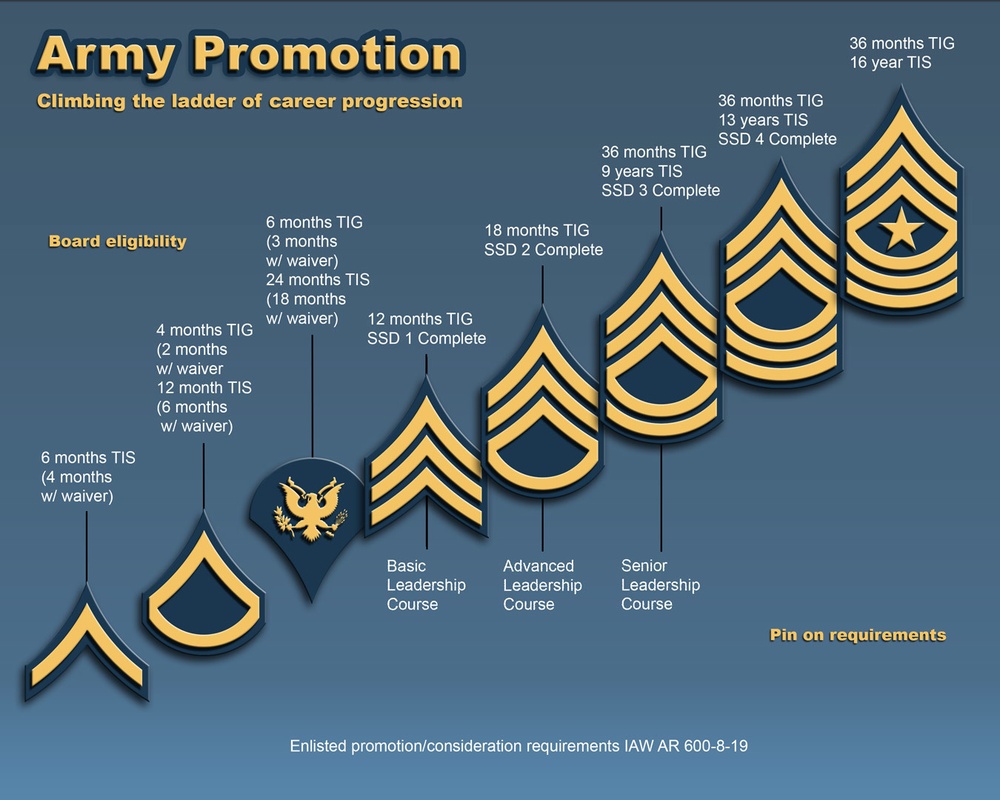
Here are the general time-in-grade requirements for promotion in the U.S. Army:
- E-1 to E-2: Automatic promotion after six months of service.
- E-2 to E-3: Automatic promotion after six months of service at E-2.
- E-3 to E-4: Automatic promotion after six months of service at E-3.
Selection Board Promotions
Selection board promotions are used for the higher enlisted ranks, such as E-5 to E-9. These promotions are based on a competitive process where individuals are evaluated by a board of senior enlisted personnel.
The selection board evaluates individuals based on a variety of factors, including:
- Performance evaluations
- Education and training
- Leadership experience
- Awards and decorations
- Physical fitness
- Community involvement
The selection board process is designed to identify the most qualified and capable individuals for promotion. The selection board process is highly competitive, and only a limited number of individuals are selected for promotion each year.
Promotion Pathways by MOS
The specific promotion pathways for enlisted personnel vary by military occupational specialty (MOS). Some MOSs have faster promotion rates than others, and some MOSs require specific training or education for promotion.
For example, an individual in a combat arms MOS, such as infantry or armor, may have faster promotion opportunities than an individual in a support MOS, such as logistics or administration. This is because combat arms MOSs often have higher attrition rates, leading to more opportunities for promotion.
Additionally, some MOSs require specific training or education for promotion. For example, an individual in a technical MOS, such as electronics or communications, may need to complete a specific technical school or course to be eligible for promotion.
The Role of Training, Education, and Experience
Training, education, and experience are essential for promotion in the military. Individuals who are committed to their professional development are more likely to be selected for promotion.
Training and education can help individuals develop the skills and knowledge necessary to succeed in their MOS and advance in their careers. Experience is also important, as it allows individuals to gain practical knowledge and skills.
The military offers a variety of opportunities for training and education, including:
- Formal military schools
- On-the-job training
- Tuition assistance programs
- Professional development courses
Individuals should take advantage of these opportunities to enhance their skills and knowledge. By doing so, they will increase their chances of being selected for promotion.
Time-In-Grade and Time-In-Service Requirements
The military’s promotion system is designed to ensure that individuals advance through the ranks based on merit, experience, and demonstrated competence. Central to this system are time-in-grade and time-in-service requirements, which play a crucial role in maintaining a structured and equitable promotion process.
Importance of Time-In-Grade and Time-In-Service Requirements
Time-in-grade and time-in-service requirements are fundamental to the military’s promotion system, serving as essential safeguards for a competent and experienced workforce. These requirements are not arbitrary; they are rooted in the understanding that leadership, expertise, and proficiency develop over time through practical experience and exposure to diverse challenges. By mandating a minimum period in a particular rank before eligibility for promotion, the military ensures that individuals have sufficient time to:* Develop and refine their leadership skills: Time in grade provides opportunities for individuals to hone their leadership skills, manage teams, and navigate complex situations.
Gain in-depth knowledge of their MOS
Spending time in a specific role allows individuals to gain a comprehensive understanding of their MOS, including its intricacies, challenges, and best practices.
Demonstrate their commitment to service
Meeting time-in-grade requirements reflects an individual’s dedication to the military and their willingness to invest time and effort in their career progression.Furthermore, these requirements contribute to a fair and transparent promotion system. They ensure that promotions are not solely based on subjective assessments or favoritism, but rather on a standardized measure of time and experience. This promotes a sense of equity and fosters trust in the promotion process.
Variation of Requirements based on Rank and MOS
Time-in-grade and time-in-service requirements vary based on the rank and MOS, reflecting the complexity of the role and the specific training and experience required. Here is a table outlining the time-in-grade and time-in-service requirements for different ranks within the military:| Rank | Time-In-Grade | Time-In-Service || ————– | ————– | ————— || E-2 to E-3 | 6 months | 2 years || E-3 to E-4 | 12 months | 3 years || E-4 to E-5 | 24 months | 4 years || E-5 to E-6 | 36 months | 6 years || E-6 to E-7 | 48 months | 8 years || E-7 to E-8 | 60 months | 10 years || E-8 to E-9 | 72 months | 12 years | Specific Examples of Variation based on MOS:* Special Forces: Due to the highly specialized nature of Special Forces training and the demanding operational requirements, time-in-grade and time-in-service requirements may be longer than those for other MOS.
Medical MOS
Medical MOS, such as medics and nurses, often have specific requirements for experience in their field, which may translate to longer time-in-grade requirements.
Cybersecurity MOS
Enlisted promotions are a critical aspect of military career progression, offering opportunities for advancement and increased responsibility. The path to promotion often involves a rigorous evaluation process, where factors like performance, education, and experience are meticulously assessed. One key element of this process is the determination of promotion point cutoff scores , which represent the minimum points required for eligibility.
These cutoff scores provide a standardized benchmark for evaluating candidates, ensuring a fair and competitive promotion system within the ranks.
Cybersecurity MOS, which involve specialized technical skills and knowledge, may require a longer time-in-service to gain the necessary expertise. Factors Influencing Variation:* Complexity of the Role: More complex and demanding roles typically require longer time-in-grade and time-in-service requirements.
Training Demands
MOS with extensive and specialized training may have longer time-in-grade requirements to ensure individuals have sufficient experience applying their knowledge.
Operational Responsibilities
MOS with significant operational responsibilities, such as those in combat arms or special operations, may have longer time-in-grade requirements to ensure individuals have adequate experience handling those responsibilities.
Impact on Career Progression
Time-in-grade and time-in-service requirements can have both benefits and challenges for individuals seeking promotions. Benefits:* Structured Career Path: These requirements provide a structured career path, ensuring that promotions are not rushed and that individuals have sufficient time to develop the necessary skills and experience.
Fair and Transparent System
The standardized nature of these requirements promotes fairness and transparency in the promotion process, reducing the potential for bias or favoritism.
Recognition of Experience and Commitment
Meeting these requirements demonstrates an individual’s commitment to their career and their dedication to serving in the military. Challenges:* Potential Delays in Promotion: Individuals may face delays in promotion if they do not meet the time-in-grade or time-in-service requirements.
Impact of Deployment Schedules
Frequent deployments can disrupt career progression by delaying time-in-grade accumulation.
Balancing Family Commitments
Meeting time-in-service requirements can be challenging for individuals with family commitments, especially if they are unable to deploy or take advantage of training opportunities. Strategies for Navigating Requirements:* Plan Ahead: Individuals should carefully plan their career path and understand the time-in-grade and time-in-service requirements for their desired rank.
Seek Opportunities for Advancement
Actively seek opportunities for advancement, such as leadership roles, training programs, and deployments.
Communicate with Supervisors
Openly communicate with supervisors about career goals and any challenges faced in meeting the requirements.
Performance Evaluation and Promotion Boards
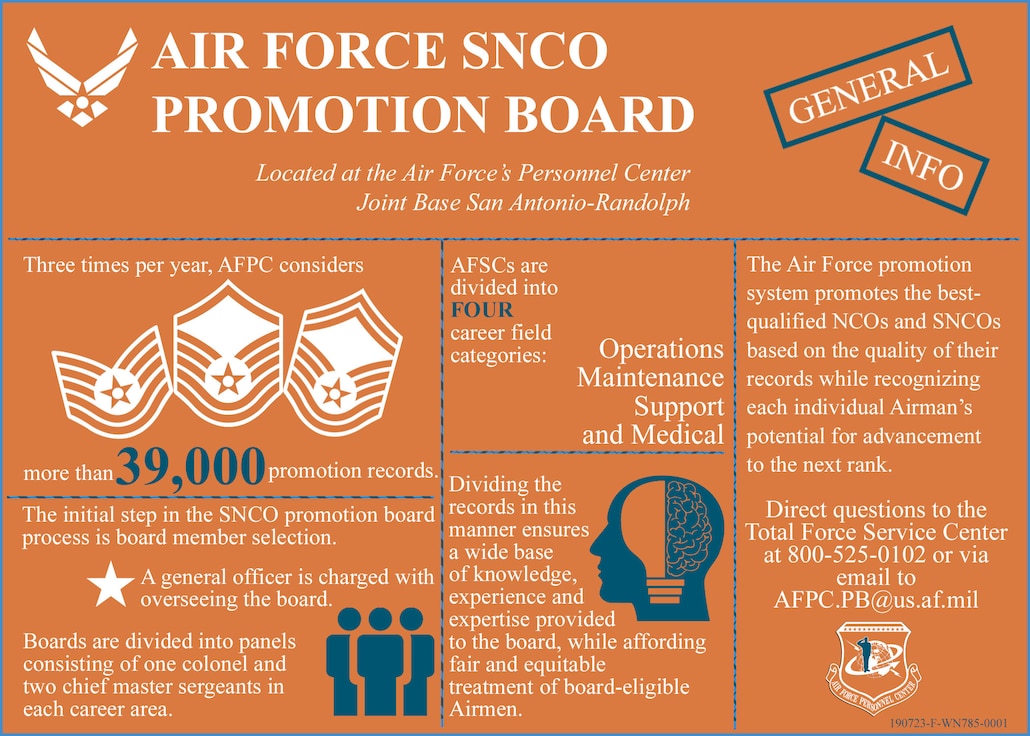
Promotion boards are a critical part of the enlisted promotion process, evaluating the performance and potential of service members for advancement. These boards are comprised of senior enlisted personnel and officers who review individual records and assess their suitability for promotion.
Performance Evaluation
Performance evaluations are the foundation of the promotion process. They provide a comprehensive assessment of an individual’s performance, leadership qualities, and potential for future growth. These evaluations are conducted regularly, typically annually, and are based on a variety of factors.
- Job Performance: This encompasses the individual’s ability to perform their assigned duties effectively, meet deadlines, and contribute to the overall mission of their unit.
- Leadership: This assesses the individual’s ability to motivate, inspire, and guide others, fostering a positive and productive work environment.
- Training and Education: This evaluates the individual’s commitment to professional development, participation in relevant courses and training programs, and their ability to apply acquired knowledge to their work.
- Physical Fitness: This factor evaluates the individual’s physical condition and their adherence to fitness standards, ensuring they are physically capable of fulfilling their duties.
- Character and Conduct: This evaluates the individual’s ethical behavior, adherence to military regulations, and their overall conduct within the military community.
Promotion Board Process
Promotion boards are typically composed of senior enlisted personnel and officers who have extensive experience and knowledge of the military. They convene to review the records of service members eligible for promotion, evaluating their performance evaluations, awards, decorations, and other relevant information.
- Record Review: The board members meticulously examine each service member’s record, paying close attention to their performance evaluations, training records, and any disciplinary actions. They also consider any special qualifications or awards received.
- Discussion and Deliberation: After reviewing the records, board members engage in a thorough discussion, considering the individual’s overall performance, potential for leadership, and suitability for advancement. They may also seek input from other senior leaders who have worked closely with the service member.
- Recommendations: Based on their deliberations, the board members make recommendations for promotion or non-promotion, taking into account the individual’s qualifications, performance, and potential for future success.
Role of Senior Leadership
Senior leadership plays a crucial role in the promotion process. They are responsible for:
- Setting Promotion Standards: Senior leaders establish the criteria and standards for promotion, ensuring that the process is fair, transparent, and aligned with the needs of the military.
- Providing Guidance and Mentorship: Senior leaders provide guidance and mentorship to service members, helping them develop the skills and knowledge necessary for promotion.
- Reviewing and Approving Promotion Recommendations: Senior leaders review and approve the recommendations made by promotion boards, ensuring that the final decisions are consistent with the established standards and the overall needs of the military.
Promotion Opportunities for Different MOS
The United States military offers a structured promotion system that rewards performance, leadership, and professional development. While the general principles of promotion are consistent across all branches, specific MOS (Military Occupational Specialties) may have unique pathways and requirements. This section explores the diverse promotion landscape within the military, highlighting the factors that influence an individual’s advancement within specific MOS.
Table of Promotion Opportunities
This table provides a general overview of promotion opportunities across various MOS. It’s important to note that these are averages and actual timeframes can vary based on individual performance, opportunities, and branch-specific policies.
| MOS | Rank | Average Time to Promotion (Years) | Typical Career Path | Unique Promotion Requirements |
|---|---|---|---|---|
| 11B (Infantry) | Sergeant | 3-4 | Private – Specialist – Corporal – Sergeant – Staff Sergeant – Sergeant First Class – Master Sergeant – Sergeant Major | Combat experience, leadership roles, and specialized training (e.g., Ranger School, Airborne School) |
| 68W (Combat Medic) | Sergeant | 3-4 | Private – Specialist – Corporal – Sergeant – Staff Sergeant – Sergeant First Class – Master Sergeant – Sergeant Major | Medical certifications, deployment experience, and advanced medical training |
| 42A (Human Resources) | Sergeant | 3-4 | Private – Specialist – Corporal – Sergeant – Staff Sergeant – Sergeant First Class – Master Sergeant – Sergeant Major | Human Resources certifications, experience in personnel management, and strong administrative skills |
| 13F (Fire Support Specialist) | Sergeant | 3-4 | Private – Specialist – Corporal – Sergeant – Staff Sergeant – Sergeant First Class – Master Sergeant – Sergeant Major | Advanced training in artillery systems, proficiency in fire support operations, and experience in combat environments |
Unique MOS Promotion Pathways
Some MOS have specialized promotion paths or requirements that distinguish them from the standard progression.
- Accelerated Promotion Paths: Programs like the Green to Gold program allow enlisted personnel to pursue a commission as an officer, potentially accelerating their career progression.
- Specialized Promotion Boards: Certain MOS, such as those in intelligence or cyber operations, may have specialized promotion boards that evaluate candidates based on unique skills and experience.
- Specific Educational Requirements: Some technical MOS, like those in the medical or engineering fields, may require specific degrees or certifications for promotion to higher ranks.
Factors Influencing Promotion Opportunities
Various factors contribute to an individual’s promotion opportunities within specific MOS.
- Performance: Strong performance evaluations, awards, and recognition significantly enhance promotion prospects. Consistently exceeding expectations demonstrates competence and dedication.
- Leadership: Assuming leadership roles, whether in formal positions or through initiative, showcases leadership potential and prepares individuals for higher ranks. Experience in leading teams, mentoring others, and taking responsibility for tasks is crucial.
- Education: Formal education, such as degrees or certifications, can be a significant asset for promotion, particularly in technical MOS. They demonstrate a commitment to professional development and specialized knowledge.
- Training: Specialized training and certifications directly related to the MOS can enhance promotion opportunities. They indicate a desire to acquire new skills and stay ahead in the field.
- Deployment: Deployment experience, particularly in combat environments, can be a valuable asset for promotion, demonstrating resilience, adaptability, and operational expertise.
- Demand: The demand for specific MOS can influence promotion rates. High-demand MOS may offer faster promotion opportunities due to the need for qualified personnel.
Enlisted Promotion Policies and Regulations
Enlisted promotion policies and regulations are essential for maintaining a capable and motivated force within the US military. These policies govern the process by which enlisted personnel advance in rank, providing them with increased responsibility, pay, and opportunities for career growth. This section delves into the promotion policies of each branch, examining recent changes, their impact on career progression, and potential areas for improvement.
Promotion Policies and Regulations by Branch
| Branch | Promotion Criteria | Promotion Boards | Promotion Rates | Recent Changes/Updates | Impact on Enlisted Career Progression |
|---|---|---|---|---|---|
| Army | Time in service, time in grade, performance evaluations, military education, and physical fitness. | Yes, for promotions to Sergeant (E-5) and above. | Vary by MOS and rank, but generally range from 60% to 80% for eligible personnel. | In 2018, the Army implemented the “Army Promotion System” (APS) which streamlines the promotion process and emphasizes holistic evaluation of Soldiers. | Positive, with increased transparency and focus on individual development. |
| Navy | Time in service, time in grade, performance evaluations, training requirements, and advancement exams. | Yes, for promotions to Petty Officer Second Class (E-5) and above. | Vary by rating and rank, but generally range from 50% to 70% for eligible personnel. | In 2020, the Navy introduced the “Navy Advancement System” (NAS) which includes a new advancement exam and a more standardized evaluation process. | Mixed, with some Sailors reporting challenges with the new exam while others appreciate the increased emphasis on technical skills. |
| Air Force | Time in service, time in grade, performance evaluations, training requirements, and promotion tests. | Yes, for promotions to Senior Airman (E-4) and above. | Vary by Air Force Specialty Code (AFSC) and rank, but generally range from 60% to 80% for eligible personnel. | In 2019, the Air Force implemented the “Air Force Promotion System” (AFPS) which includes a new promotion test and a more streamlined evaluation process. | Positive, with increased transparency and focus on individual development. |
| Marines | Time in service, time in grade, performance evaluations, and training requirements. | Yes, for promotions to Corporal (E-4) and above. | Vary by MOS and rank, but generally range from 60% to 80% for eligible personnel. | In 2021, the Marines implemented the “Marine Corps Promotion System” (MCPS) which includes a new promotion test and a more standardized evaluation process. | Mixed, with some Marines reporting challenges with the new exam while others appreciate the increased emphasis on technical skills. |
| Space Force | Time in service, time in grade, performance evaluations, training requirements, and promotion tests. | Yes, for promotions to Senior Airman (E-4) and above. | Data is limited due to the Space Force’s recent establishment, but promotion rates are expected to be similar to the Air Force. | The Space Force has adopted the Air Force’s promotion system, with minor modifications to reflect its unique mission. | Positive, with a clear and structured promotion system in place. |
Recent Changes and Impact on Enlisted Career Progression
Recent changes to enlisted promotion policies have been driven by a desire to improve fairness, transparency, and efficiency in the promotion process. These changes have had a mixed impact on enlisted career progression, with some branches experiencing positive outcomes while others face challenges.
- Army: The Army’s implementation of the APS has led to increased transparency in the promotion process, with a greater emphasis on individual development and holistic evaluation. This has positively impacted career progression by providing Soldiers with a clearer understanding of the promotion criteria and opportunities.
- Navy: The Navy’s NAS has introduced a new advancement exam, which has been met with mixed reactions. Some Sailors have found the exam challenging, leading to concerns about fairness and the impact on promotion rates. However, the NAS also emphasizes technical skills, which is viewed positively by many Sailors.
- Air Force: The Air Force’s AFPS has introduced a new promotion test and a more streamlined evaluation process. This has been well-received by Airmen, with the new system providing greater transparency and a more consistent evaluation process.
- Marines: The Marines’ MCPS has introduced a new promotion test and a more standardized evaluation process. This has been met with mixed reactions, similar to the Navy’s NAS. Some Marines have found the exam challenging, while others appreciate the increased emphasis on technical skills.
- Space Force: The Space Force has adopted the Air Force’s promotion system, which has provided a clear and structured promotion system for its personnel. This has positively impacted career progression by ensuring a consistent and fair process.
Impact on Enlisted Career Progression
Current promotion policies have a significant impact on enlisted career progression, influencing factors such as time to promotion, career advancement opportunities, retention rates, and morale.
- Time to Promotion: Promotion policies directly impact the time it takes for enlisted personnel to advance in rank. In some branches, the time to promotion can be lengthy, particularly for higher ranks, which can discourage retention and career advancement.
- Career Advancement Opportunities: Promotion policies shape the opportunities for career advancement within the military. Branches with more streamlined and transparent promotion systems tend to have higher retention rates and greater career progression opportunities for their enlisted personnel.
- Retention Rates: Promotion policies play a crucial role in retention rates. Enlisted personnel who perceive the promotion system as fair and transparent are more likely to remain in service.
- Morale and Motivation: Promotion policies can significantly impact morale and motivation among enlisted personnel. A fair and transparent promotion system fosters a sense of fairness and encourages hard work and dedication.
Strengths and Weaknesses of Current Promotion Policies
While current promotion policies aim to ensure a fair and merit-based system, they also present certain strengths and weaknesses.
- Strengths:
- Emphasis on Merit: Promotion policies generally emphasize merit, with performance evaluations and training playing a significant role in determining promotion eligibility.
- Transparency: Most branches have made efforts to increase transparency in the promotion process, providing enlisted personnel with clearer guidelines and expectations.
- Opportunities for Advancement: The promotion system provides opportunities for career advancement, allowing enlisted personnel to progress in rank and responsibility.
- Weaknesses:
- Time to Promotion: The time to promotion can be lengthy in some branches, particularly for higher ranks, which can discourage retention and career advancement.
- Subjectivity in Evaluation: Performance evaluations can sometimes be subjective, which can lead to inconsistencies in the promotion process.
- Limited Promotion Opportunities: Not all eligible personnel are promoted, leading to frustration and a sense of unfairness among those who are not selected.
Recommendations for Improvement
To address the weaknesses of current promotion policies and enhance their effectiveness, several recommendations can be considered.
- Streamline the Promotion Process: Simplifying the promotion process, reducing bureaucratic hurdles, and providing clear timelines can enhance efficiency and increase the satisfaction of enlisted personnel.
- Reduce Time to Promotion: Accelerating the promotion process, particularly for higher ranks, can increase retention rates and encourage career advancement.
- Improve Objectivity in Evaluation: Implementing more objective evaluation criteria and standardized performance evaluation processes can reduce subjectivity and ensure fairness.
- Increase Promotion Opportunities: Expanding promotion opportunities for eligible personnel, particularly for those in high-demand specialties, can improve morale and retention rates.
- Enhance Transparency and Communication: Providing regular updates on promotion policies and procedures, and ensuring open communication with enlisted personnel, can foster trust and transparency.
Challenges and Barriers to Enlisted Promotions
The path to enlisted promotion in the military can be arduous, often presenting a range of challenges that impact service members’ career progression. These challenges, ranging from intense competition to limited opportunities, can significantly affect morale and retention rates. Understanding these barriers is crucial for developing effective strategies to improve the promotion system and enhance service members’ overall experience.
The Top Three Challenges Faced by Enlisted Personnel
The top three most common challenges faced by enlisted personnel in pursuing promotions are:
- Intense Competition: The military often has a limited number of promotion slots available, leading to fierce competition among qualified individuals. This can create a highly competitive environment where even high-performing individuals may face difficulty advancing. For example, in a unit with multiple individuals exceeding the minimum requirements for promotion, only a select few may be chosen, leaving others to wait for the next promotion cycle.
This can lead to frustration and a sense of unfairness.
- Limited Opportunities: Some military occupational specialties (MOS) have fewer promotion opportunities compared to others. This disparity can be attributed to factors such as the demand for specific skills, the number of personnel in a particular MOS, or the overall structure of the military. For instance, certain technical MOSs might have limited promotion slots due to their specialized nature and limited career paths.
This can create a sense of stagnation and limit career growth for individuals in these MOSs.
- Strict Time-In-Grade and Time-In-Service Requirements: The military imposes specific time-in-grade and time-in-service requirements for promotion eligibility. While these requirements are designed to ensure experience and maturity, they can also act as barriers for individuals who are eager to advance. For example, a highly motivated individual who has excelled in their current rank may have to wait a considerable amount of time before becoming eligible for promotion, potentially leading to a loss of motivation and a sense of being stuck in their current position.
Factors Impacting Enlisted Promotions
The following table Artikels the factors influencing enlisted promotions and their impact on individuals’ career progression:
| Factor | Description | Impact on Promotions |
|---|---|---|
| Competition | The number of qualified individuals vying for a limited number of promotion slots. | High competition can make it challenging to stand out and secure a promotion, even for highly qualified individuals. |
| Quotas | Predetermined limits on the number of promotions allowed per unit or MOS. | Quotas can restrict promotion opportunities, even if there are many qualified individuals, creating a sense of limited advancement potential. |
| Limited Opportunities | Disparities in promotion opportunities across different MOSs or units. | Individuals in MOSs with fewer promotion opportunities may face longer wait times or have fewer chances to advance, leading to frustration and potentially impacting retention. |
Psychological Impact of Promotion Challenges
The challenges associated with enlisted promotions can have a significant psychological impact on service members, affecting their morale and retention rates.
- Frustration and Disillusionment: Facing constant competition, limited opportunities, and lengthy wait times can lead to feelings of frustration and disillusionment. Individuals may feel that their hard work and dedication are not being recognized or rewarded, leading to a decrease in motivation and job satisfaction.
- Lack of Motivation: The perception of limited promotion opportunities can significantly impact motivation. Individuals may feel that their career growth is limited and that their efforts will not be rewarded, leading to a decrease in enthusiasm and a lack of desire to excel in their current roles.
- Increased Attrition: High levels of frustration, disillusionment, and lack of motivation can contribute to increased attrition rates. Service members may choose to leave the military if they feel their career progression is being hampered or their efforts are not being valued.
Potential Solutions to Address Promotion Challenges
To mitigate the challenges and barriers to enlisted promotions, the military can implement a range of solutions:
- Increase Promotion Opportunities: Expanding the number of promotion slots available, particularly in MOSs with limited opportunities, can create a more equitable and motivating environment. This can be achieved by re-evaluating promotion quotas and considering factors such as unit size, mission requirements, and overall personnel needs.
- Revise Time-In-Grade and Time-In-Service Requirements: Adjusting these requirements, particularly for high-performing individuals, can create a more flexible and responsive promotion system. This could involve recognizing exceptional performance and allowing for faster advancement based on merit rather than solely on time spent in rank.
- Implement a More Transparent and Objective Promotion System: Establishing clear and transparent criteria for promotion, emphasizing performance, leadership qualities, and contributions, can create a more fair and merit-based system. This can involve developing comprehensive evaluation systems that accurately reflect an individual’s skills, abilities, and potential.
Strategies for Enlisted Personnel to Enhance Promotion Opportunities
Enlisted personnel can take a proactive approach to maximize their chances of promotion. This involves a combination of dedication to duty, continuous learning, and building strong professional relationships. By focusing on these areas, enlisted personnel can significantly increase their competitiveness for promotion.
Professional Development
Professional development is essential for enlisted personnel seeking promotion. It demonstrates a commitment to continuous learning and improvement, which is highly valued by promotion boards.
- Formal Education: Pursuing higher education, such as a bachelor’s or master’s degree, can significantly enhance an individual’s qualifications. This demonstrates a commitment to intellectual growth and leadership potential.
- Military Education: Attending military schools and courses, like the Sergeants Major Academy or the Army War College, provides specialized knowledge and skills essential for leadership roles. These courses also build a network of peers and mentors.
- Professional Certifications: Obtaining industry-specific certifications can demonstrate expertise and a commitment to professional development. These certifications can be particularly valuable for technical MOSs.
Mentorship and Networking
Mentorship and networking play a crucial role in career advancement. Mentors provide guidance and support, while networking helps build relationships with influential individuals.
- Seeking Mentors: Identify senior enlisted personnel or officers who have achieved success and can offer valuable advice and guidance.
- Building Relationships: Attend professional events, participate in professional organizations, and actively engage with colleagues to build a strong network.
- Mentoring Others: Mentoring junior enlisted personnel demonstrates leadership qualities and provides valuable experience in guiding others.
Successful Strategies
Many successful enlisted personnel have employed strategies to enhance their promotion opportunities.
- Active Participation: Volunteering for challenging assignments, leading teams, and taking on additional responsibilities demonstrates initiative and leadership potential.
- Performance Excellence: Consistently exceeding expectations in all duties, receiving positive performance evaluations, and achieving awards and recognition are critical for promotion.
- Community Involvement: Participating in community service and volunteer work demonstrates a commitment to service and leadership outside the military.
The Importance of Enlisted Promotions for Military Readiness
Enlisted promotions are crucial to maintaining a strong and effective military force. They provide a structured path for advancement, fostering motivation, morale, and a sense of purpose within the ranks. Promotions not only reward individual achievements but also contribute significantly to the overall readiness and effectiveness of the military.
Impact of Promotions on Motivation, Morale, and Training
Promotion opportunities serve as a powerful motivator for enlisted personnel. The prospect of advancement encourages them to excel in their duties, strive for professional development, and actively participate in training. A well-defined promotion system fosters a culture of continuous learning and improvement within a unit. When soldiers see a clear path for advancement, they are more likely to be engaged and committed to their roles, leading to higher morale and a stronger sense of belonging.
This, in turn, translates into improved performance during training and readiness for operational deployments.
The Role of Experienced and Qualified Enlisted Personnel
Experienced and qualified enlisted personnel are essential for unit effectiveness. These individuals possess a deep understanding of their specialties, have developed critical skills through years of experience, and are adept at mentoring and guiding junior personnel. They provide invaluable expertise in training, troubleshooting, and operational execution, ensuring the smooth functioning of a unit. For example, a highly experienced Sergeant in a combat arms unit can effectively train new recruits on weapons handling, tactics, and combat procedures, significantly contributing to the unit’s readiness.
Their knowledge and skills also contribute to a more efficient training process, saving time and resources while maximizing the effectiveness of training programs.
Impact of Promotion Policies on Retention
Promotion policies have a direct impact on the retention of skilled personnel. A fair and transparent promotion system that recognizes merit and experience is crucial for attracting and retaining highly qualified individuals. When enlisted personnel believe that the promotion process is fair and that their contributions are valued, they are more likely to remain in service. Conversely, a system perceived as unfair or biased can lead to frustration and discouragement, potentially driving talented individuals to seek opportunities elsewhere.
Therefore, maintaining a system that aligns promotion timelines, criteria, and perceived fairness with the needs of skilled personnel is essential for retaining valuable talent within the military.
Comparison of Merit-Based vs. Seniority-Based Promotion Systems
| Feature | Merit-Based System | Seniority-Based System ||—|—|—|| Motivation | Higher motivation, as individuals are encouraged to excel for advancement. | Lower motivation, as advancement is primarily based on time in service. || Unit Performance | Improved unit performance due to a focus on talent and competence. | Potential for stagnation and decreased performance due to a lack of emphasis on merit.
|| Military Readiness | Enhanced military readiness as units are composed of highly qualified and motivated personnel. | Potential for reduced readiness as less emphasis is placed on individual skill and competence. |
12. Historical Overview of Enlisted Promotion Systems: Enlisted Promotions
The evolution of enlisted promotion systems within the military reflects a complex interplay of historical events, social norms, and evolving strategic priorities. From the earliest forms of military organization to the modern, sophisticated systems of today, the methods of recognizing and rewarding enlisted service have undergone significant transformations. This historical overview delves into the key milestones, foundational principles, and transformative shifts that have shaped the landscape of enlisted promotions.
Part 1: The Foundation
The earliest forms of military organization often relied on informal systems of promotion based on experience, leadership qualities, and loyalty. These early systems were often characterized by a lack of standardized criteria and procedures. The development of formal promotion systems emerged alongside the rise of professional armies and the need for a more structured and meritocratic approach to advancement.
- Timeline:
- Early 18th Century: The emergence of standing armies in Europe led to the development of rudimentary promotion systems based on seniority and battlefield performance. Promotions were often awarded based on the recommendation of officers and the perception of individual courage and competence.
- Mid-19th Century: The Industrial Revolution and the rise of mass armies led to the development of more formal promotion systems, often based on a combination of experience, education, and standardized tests. These systems aimed to identify and promote individuals with the skills and knowledge required to lead and manage larger and more complex military units.
- Early 20th Century: The introduction of specialized military roles and the increasing importance of technical skills led to the development of promotion systems that recognized and rewarded expertise in specific areas. This period saw the emergence of promotion boards and formalized evaluation processes.
- Post-World War II: The development of the modern military, with its emphasis on advanced technology and complex logistics, led to the development of more sophisticated promotion systems that incorporated a wide range of criteria, including performance evaluations, education, and professional development.
- Foundational Principles:
- Merit: The principle of merit, based on the idea that promotions should be awarded to individuals who demonstrate the highest levels of competence and performance, emerged as a core principle guiding the development of promotion systems. This principle sought to ensure that promotions were based on objective criteria and not on personal connections or favoritism.
- Leadership: The ability to lead and motivate others was another foundational principle. Promotion systems aimed to identify and promote individuals who possessed the qualities and skills necessary to lead and inspire their subordinates.
- Professionalism: The development of professional armies, with their emphasis on training, education, and ethical conduct, led to the inclusion of professionalism as a core principle in promotion systems. Promotions were seen as a reward for dedication to professional development and adherence to military standards.
- Early Structures:
- Seniority: In the early stages of military development, seniority was often the primary determinant of promotion. Individuals who had served for the longest period of time were often given preference for advancement. This system was relatively simple to administer but could lead to the promotion of individuals who lacked the necessary skills and leadership qualities.
- Recommendation: Officers often played a significant role in recommending enlisted personnel for promotion. Their recommendations were based on their observations of individual performance and their assessment of the individual’s potential for leadership. This system was often subject to personal bias and favoritism.
- Battlefield Performance: In times of war, battlefield performance was often a major factor in determining promotions. Individuals who distinguished themselves in combat were often rewarded with rapid advancement. This system was highly subjective and could be influenced by factors beyond the individual’s control.
Future Trends in Enlisted Promotions
The landscape of enlisted promotions is continuously evolving, driven by technological advancements, shifting military requirements, and a growing emphasis on talent management. These trends will have a significant impact on enlisted career progression, presenting both opportunities and challenges for service members.
Technological Advancements and Enlisted Promotions
Technological advancements are reshaping the military landscape, impacting how enlisted personnel are trained, deployed, and promoted. These advancements have the potential to streamline promotion processes and enhance the efficiency of promotion boards.
- Artificial Intelligence (AI) in Promotion Boards: AI algorithms can analyze vast datasets of performance data, identifying patterns and trends that might be missed by human reviewers. This can lead to more objective and data-driven promotion decisions.
- Automated Performance Tracking Systems: Digital platforms can track performance metrics, training records, and qualifications in real-time, providing a comprehensive view of an individual’s career progression. This can simplify the promotion process and ensure accurate data for promotion boards.
- Virtual Reality (VR) and Augmented Reality (AR) Training: VR and AR technologies can create immersive training environments, allowing enlisted personnel to practice skills and demonstrate proficiency in a cost-effective and efficient manner. This can enhance their readiness for promotion and contribute to a more competitive pool of candidates.
Evolving Military Requirements and Enlisted Promotions
The evolving nature of military operations and the increasing demand for specialized skills are influencing enlisted promotion policies. This shift necessitates a focus on developing and retaining talent in critical areas.
- Emphasis on Cyber Security and Digital Warfare: The growing reliance on technology in warfare has led to a surge in demand for cyber security professionals. Enlisted personnel with expertise in this field are likely to experience accelerated promotion opportunities.
- Focus on Multi-Domain Operations: The concept of multi-domain operations, encompassing land, sea, air, space, and cyber domains, requires personnel with diverse skillsets. This could lead to changes in promotion criteria, rewarding individuals with cross-functional expertise.
- Increased Emphasis on Leadership and Communication Skills: As the military embraces a more technology-driven approach, the need for effective communication and leadership skills becomes paramount. Promotion criteria might place a greater emphasis on these skills.
Commonly Asked Questions
What are the common benefits of receiving an enlisted promotion?
Enlisted promotions bring numerous benefits, including increased pay, greater responsibility, leadership opportunities, enhanced career prospects, and a sense of accomplishment. They signify recognition for hard work, dedication, and professional development.
How often do enlisted promotions occur?
The frequency of enlisted promotions varies based on factors like rank, MOS, and branch of service. Some promotions are awarded annually, while others may occur less frequently. Promotion timelines are generally influenced by time-in-grade, performance, and the availability of open positions.
What are the most common reasons for enlisted personnel not receiving a promotion?
Common reasons for not receiving a promotion include failing to meet time-in-grade requirements, receiving unsatisfactory performance evaluations, lacking necessary training or certifications, and facing limited promotion opportunities due to factors like quotas or MOS demand.
What are some effective strategies for enhancing promotion opportunities?
Strategies to enhance promotion opportunities include excelling in performance, seeking leadership roles, actively participating in professional development programs, networking with senior leaders, and maintaining a strong understanding of promotion policies and requirements.
Is there a difference between promotion policies for officers and enlisted personnel?
Yes, promotion policies for officers and enlisted personnel differ significantly. Officer promotions often involve a more formal selection process, requiring board appearances, educational qualifications, and a greater emphasis on leadership experience.

Whitney Morris is a renowned author with a passion for military history and strategic analysis. Born in Jakarta, Indonesia, Defense developed a deep fascination for warfare and national defense from a young age. His unwavering interest in military strategy, combined with his natural storytelling ability, has earned him a reputation as an engaging and insightful writer in the field.
